How to use a rangefinder for bowhunting from a tree stand: range five or six landmarks around your stand as soon as you are settled, use angle-compensated (horizontal) distance rather than line-of-sight distance, and range the deer only if you have time and cover to do it without being seen. Most of the time, your pre-ranged landmarks will tell you the distance before you ever need to lift the rangefinder.
A rangefinder is the most useful tool a bowhunter carries after the bow itself. Arrows drop quickly past 30 yards, so misjudging distance by five yards is the difference between a heart shot and a miss or wound. Here is how to get fast, accurate, quiet readings from an elevated stand.
Why does angle matter when you shoot from a tree stand?
Gravity affects an arrow over the horizontal distance to the target, not the straight-line distance. From a stand 20 feet up, a deer at 15 yards line-of-sight is noticeably closer horizontally. Shoot your line-of-sight pin and you will hit high, often over the deer’s back. Angle-compensating rangefinders calculate the horizontal (“shoot-as”) distance for you.
| Line-of-sight distance | Angle (downhill) | Horizontal distance (approx.) |
|---|---|---|
| 15 yds | 30° | 13 yds |
| 20 yds | 25° | 18 yds |
| 30 yds | 20° | 28 yds |
| 40 yds | 15° | 39 yds |
Figures are calculated with basic trigonometry (horizontal = line-of-sight × cosine of the angle) and rounded. Your rangefinder does this automatically in its angle-compensated mode, called HCD on Vortex models and TBR or bow mode on Leupold.
Step 1: Choose the right rangefinder
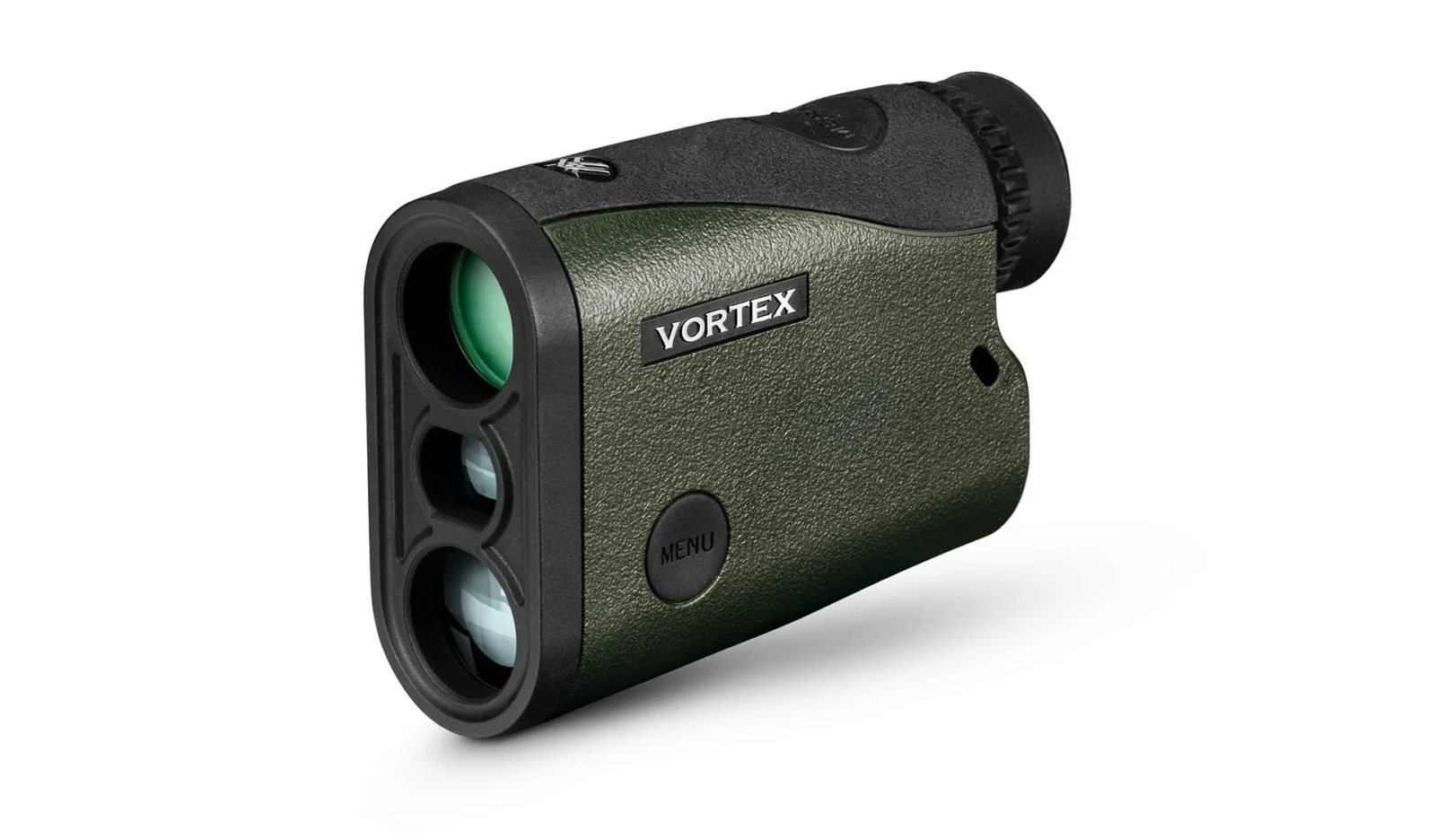
For tree-stand bowhunting you need angle compensation, a short minimum range (5–6 yards) and a size that fits in a pocket or bino harness. You do not need 1,000+ yards of deer range. Good choices include the Vortex Crossfire HD 1400 (4.8 oz, ±89° angle reading), the Leupold RX-1400i TBR/W Gen 2 (5.1 oz, dedicated bow mode) and the budget Vortex Triumph HD 850 (4.6 oz, ±0.5-yard accuracy). Compare more in our rangefinders category.
Step 2: Set the right mode before the season
Switch the rangefinder to its angle-compensated mode (HCD, TBR, bow mode) and choose yards. If it has target priority, use “last target” or “best” mode in timber so it ignores twigs in front of the deer. Practice in your backyard from a deck or ladder so the button presses become automatic.
Step 3: Range landmarks as soon as you settle in
Once you are hooked in and your bow is hung, slowly range five or six objects in your shooting lanes: a stump at 15, a forked tree at 22, the edge of the scrape at 28, the field corner at 35. Some hunters write them on a small card taped to the bow riser. When a deer walks past the forked tree, you already know it is about 22 yards, and you never have to move.
Step 4: Range the deer only when it is safe
If a deer stops between landmarks and you have time, raise the rangefinder slowly with your hand in front of your body, not out to the side. Range when the deer’s head is behind a tree or it is looking away. Aim the reticle at the deer’s shoulder, not the outline, so the laser hits the body and not the brush behind it. If the reading jumps around, range something solid right beside the deer.
Step 5: Pick the pin and shoot
Use the angle-compensated distance to choose your pin, and gap shoot between pins if the reading falls in the middle (for example, 27 yards on a 20/30 pin setup). A single-pin slider sight lets you dial the exact yardage, but only if the deer gives you time.
How do you carry a rangefinder quietly?
Noise and movement are what get bowhunters busted, not the rangefinder itself. Keep it in a magnetic or elastic-closure case such as the Badlands RF Mag on your bino harness, and clip on a retractable tether so it can never fall from the stand. Avoid zippered pockets and Velcro.
What are the most common mistakes?
- Using line-of-sight distance from height. Always use the angle-compensated reading.
- Ranging the deer instead of landmarks. Too much movement at close range.
- Ranging through brush. The laser hits a twig; switch to last-target mode or range a nearby trunk.
- Dead battery in the cold. CR2 lithium batteries weaken below freezing. Carry a spare in an inside pocket.
- Not practicing. Shoot from your stand height in the off-season, ranging and shooting real targets.
Should you use a rangefinder on a saddle or ground blind?
Yes. Saddle hunters face the same angle issues as stand hunters, and the lighter the rangefinder the better. In a ground blind, angle compensation matters less, but pre-ranging landmarks through each window is just as useful.
How do you practice ranging before the season?
Set out 3D targets at unknown distances in your yard or at a 3D range, climb a ladder stand or deck, range each target and shoot it. Then walk out and pace the distance to confirm. Do this a few times and you will trust your readings, learn how your rangefinder behaves on different backgrounds, and get faster at picking the right pin under pressure.
What should you do when a deer appears suddenly?
Freeze, judge the distance against your nearest landmark, and decide whether you even need the rangefinder. If the deer is within a few yards of a ranged landmark, trust that number and focus on drawing undetected. Only reach for the rangefinder if the deer is in an unranged spot and is relaxed, feeding or looking away. When in doubt, let the deer walk to a known spot.
How do you range in low light?
The first and last minutes of shooting light are when most bowhunting shots happen and when displays and targets are hardest to see. Rangefinders with red OLED displays, such as the Cabela’s Pro 2400C, are easier to read against dark timber than black LCD displays. Range landmarks while there is still good light, and in deep shadow range a lighter object such as a pale tree trunk next to the deer.
How to use a rangefinder for bowhunting: key takeaways
- Always use the angle-compensated reading from an elevated stand.
- Pre-range landmarks so you rarely need to range the deer itself.
- Carry the rangefinder in a quiet case with a tether.
- Keep a spare battery warm in an inside pocket.
- Practice ranging and shooting from height before the season.
Does a rangefinder replace practice at unknown distances?
No. Sometimes you will not have time to range at all, so it pays to train your eye. During the off-season, guess the distance to objects on walks, then check with the rangefinder. Over a few weeks your estimates get far more accurate, and the rangefinder becomes a confirmation tool rather than a crutch. This also helps you spot when a reading is clearly wrong because the laser hit a branch in front of the deer.
Specifications in this guide come from the manufacturers’ official websites: Vortex, Leupold, Badlands. Prices are current at the time of writing; check each product page for today’s price.
Frequently asked questions
Do I need angle compensation for bowhunting?
From a tree stand or saddle, yes. Without it you will tend to shoot high on close, steep shots.
What rangefinder mode should I use for bowhunting?
The angle-compensated mode (HCD on Vortex, TBR or bow mode on Leupold) and last-target or best mode in timber.
How many yards should a bowhunting rangefinder range?
Any hunting rangefinder easily covers archery distances; 500–750 yards of deer range is plenty.
How do I range a deer without being seen?
Range landmarks before deer arrive, and only range the deer when its head is behind cover or turned away.